
The Samara Flag
The Samara Flag, and the time the artist met the warrior...

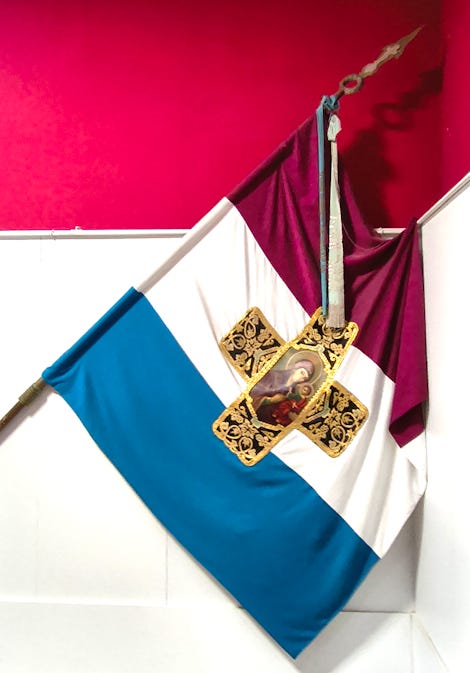
The Samara flag is a Bulgarian battle flag, and one of the most important military symbols of the Bulgarian Army. It was created by nuns from the city of Samara, Russia, and was donated to the Bulgarian militia during the Russo-Turkish War (1877 – 1878).
The idea for the flag was proposed by Piotr Vladimirovich Alabin (later governor of Samara) and his wife. The couple believed that a regiment flag would become a powerful symbol that would inspire the Bulgarian volunteers to fight on.
The flag became famous during the Battle of Stara Zagora. During the battle the flag-bearers were killed. A number of Bulgarian volunteers rushed in to save their flag and the symbol of their commitment to continue fighting to liberate Bulgaria, among them was Nikola Korchev.
In 1902, a grand celebration was organised to mark the 25th anniversary of the battles of the Shipka, a turning point in the Russo-Turkish war and the Liberation of Bulgaria. Survivors of the battle were invited to take part. Nikola Korchev, as the savoir of the flag was entrusted with flying the Samara flag.
At this event Yaroslav Veshin sees Nikola Korchev. The image of Korchev holding the flag stays with Veshin, and in 1911 he invites Korchev to pose for the painting. By the time Veshin paints Korchev, Korchev is an old man, but the artist catches beautifully Korchev pride and strength.
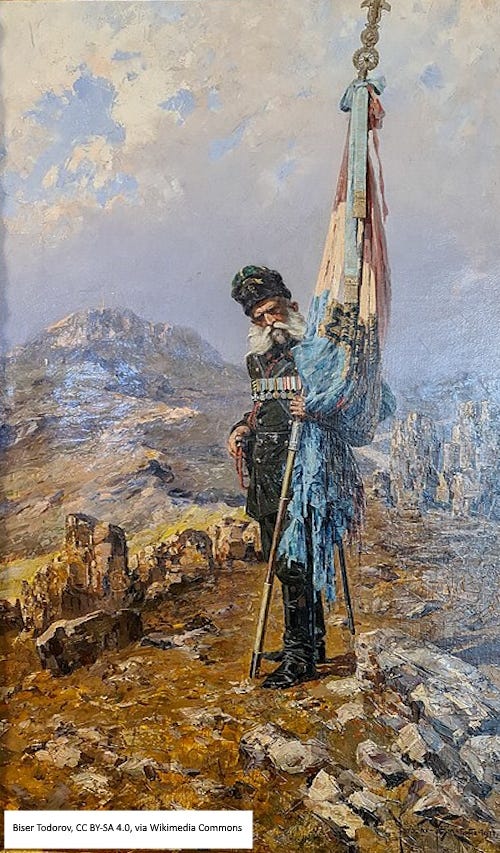
Jaroslav František Julius Věšín ( 1860 – 1915) was a Czech painter. He studied at the Prague Academy of Art, then he moved to the Art Academy in Munich. After graduation, he lived and worked in Munich and Slovakia, most of his painting depicted rural life in Slovakia. In 1897 at the invitation of the Minister of National Education, Yaroslav Veshin moved to Bulgaria. He was a senior professor at the National Academy of Art until 1904, then he joined the Ministry of War as a War Artist.
His style belongs to the realism movement of the 1880s. Realism emerges as a rejections of the melodramatic and the picturesqueness. Artists such as Věšín turn their attention to the depiction of everyday live, especially in rural or semi-rural setting. Věšín is known for his depiction of life in the Bulgarian countryside, as well as for his work as a war artist.